from 19/05/2025 to 19/12/2025
19/05/25 – 19/12/25. Temporary exhibition “At the Origins of the University of Pavia: History, Myths, and History of Myths”
New exhibition by the Museum of the History of the University, in collaboration with CeSUP: "At the Origins of the University of Pavia: History, Myths, and the History of Myths." Opening on Monday, May 19, 2025; closing on Friday, December 19, 2025
Description of the event
When and how was the University of Pavia founded? Where do the myths defining its identity originate? To whom should its founding be attributed?
A new temporary exhibition at the Museum for the History of the University of Pavia—organized in collaboration with CeSUP (Center for the History of the University of Pavia)—seeks to answer these questions. Its primary objective is to distinguish myth from the facts established by historical research, while also highlighting and valuing the precious fragments of history and genuine cultural greatness that were used to construct the cruder amalgam of the University of Pavia’s founding myths
The exhibition “At the Origins of the University of Pavia: History, Myths, and the History of Myths” will open on Monday, May 19, 2025, at 6:00 PM; admission to the museum and the guided tour will be provided free of charge to attendees.
The exhibition, set up in the temporary exhibition hall of the Museum for the History of the University of Pavia, will be open to visitors from May 20 to December 19, 2025, during regular museum hours (Tuesdays 3:00 PM–6:00 PM, Wednesdays 10:00 AM–1:00 PM, Fridays 10:00 AM–1:00 PM) with the purchase of a standard admission ticket. Guided tours will be organized throughout the year on Tuesdays at 4:30 PM (starting May 27) and on select Saturdays and Sundays listed on the Museum’s website (https://museoperlastoria.unipv.it/), available by reservation for an additional fee of €5.
The exhibition will explore the history not only of the most famous myth linking the University of Pavia’s founding to the Capitulary of Lothair (825 AD), but also of two earlier, lesser-known myths that attributed the institution’s origins to the Lombard kings and Charlemagne.
The University was officially established on April 13, 1361, with the founding of the Studium Generale at the behest of Galeazzo II Visconti. However, over the centuries, three distinct origin stories have been proposed: the first—a Lombard myth—was put forward by the Visconti family themselves as part of a strategy to legitimize their political rule, envisioning the new institution as a continuation of the traditions and glorious past of the Lombard kingdom’s capital.
The second myth—the Carolingian one—took hold in the early 16th century, linking the University’s founding directly to Charlemagne and to the presence in Pavia of an Irish monk sent by the emperor (as was the case elsewhere in Europe) to foster the advancement of learning. This myth was propagated primarily by the university’s alumni, who were keen to lend prestige to their alma mater.
In the 18th century, these myths began to face critical historical scrutiny. Ludovico Antonio Muratori pioneered this scholarly approach, which aimed to “free the truth from so many fables”; he is credited not only with the first printed edition of Lothair I’s capitulary of 825 but also with a perceptive analysis questioning whether a line of continuity could truly be drawn between Pavia’s glorious cultural past and the actual founding of the University of Pavia during the Visconti era.
The third myth—attributing the University’s foundation to Lothair’s capitulary of 825—emerged in 1925 at the initiative of the University of Pavia itself. The aim was to reaffirm the institution’s glorious, enduring stature, particularly in light of the very recent establishment of the University of Milan in 1924. Alongside this claim—which allowed the university to boast an eleven-century history—a second line of argument was advanced to rival the antiquity of the University of Bologna: this cited the existence in 11th-century Pavia of a legal “school” associated with Lanfranc and the “ancient masters of Pavia.” The celebrations were grand, drawing—among others—numerous representatives from universities worldwide and King Victor Emmanuel III of Italy, who was awarded an honorary degree and presided over the unveiling of the monument to Lanfranco and other jurists from Pavia, erected in the Rectorate courtyard.
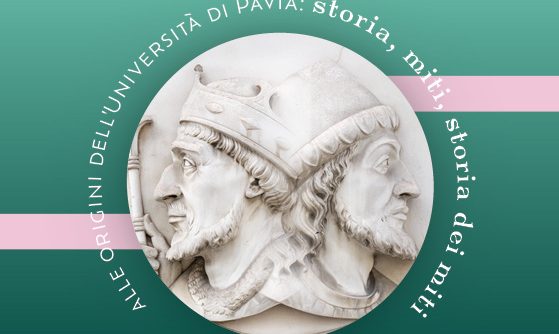
The Lothair myth was cemented in 1961 during the celebrations marking the 600th anniversary of the university’s actual founding. For the occasion, it was decided to install the two bas-reliefs—depicting Emperor Lothair and the founder Galeazzo II Visconti—that can be seen today at the entrance to the University’s Main Building. However, an unfortunate case of mistaken identity led to the depiction of a “fake Lothair” instead of the real one. The exhibition will also recount this story, notably through the use of enlarged 3D reconstructions of the seals featuring the two emperors.
Scientific Committee: Lucio Fregonese, Dario Mantovani
Curators: Ester Maria Bernardi, Anna Letizia Magrassi Matricardi, Silvia Sanza
Location
Museo per la Storia dell'Università di Pavia
Contacts
-
0382.98 4659
-
museo.storico@unipv.it